
Monday morning. Wardrobe open. Fifteen minutes before you need to leave. You own more clothes than you did three years ago, and somehow the problem is worse. You grab the navy blazer again — not because it’s right, but because it always technically works.
This is not a shopping problem. It’s a system problem. Building a work wardrobe piece by piece, based on what catches your eye at the point of purchase, produces a collection with no internal logic. Individual pieces look fine. Together, they don’t cohere. Themes solve this directly: they give each piece a relationship to the others and tell you what to buy next, what to retire, and how to get dressed in under five minutes without standing in front of an open wardrobe.
There’s a meaningful difference between a theme and a vague instruction like “look polished.” A theme is structural. It shapes the selection of pieces you own, not just how you feel about them in isolation. The five themes below are worth building around — with honest notes on what each one costs to start and where each one fails.
Why “Dress Professionally” Is Not Useful Style Advice
Every workplace dress code guide lands on the same instructions. Neutral colors. Avoid loud prints. Blazers are safe. This advice isn’t wrong — it’s just incomplete. It describes a floor, not a direction. It tells you what not to wear without giving you any organizing logic for deciding what to wear instead.
The result is a wardrobe full of individually appropriate pieces that don’t work together. A grey blazer that doesn’t match any of your trousers. Three pairs of black work trousers from different shopping sessions with slightly different cuts. Five blouses in almost-but-not-quite-the-same shade of white. Each piece was a reasonable decision in isolation. Together, they don’t form a wardrobe — they form a pile that requires active problem-solving every morning.
What “professional” also fails to communicate is what it leaves open. It rules out denim and graphic tees but says nothing about whether you should build around structure or softness, pattern or solid, color or neutral. That enormous remaining space — everything not ruled out — is where most people make expensive, incoherent decisions for years.
How decision fatigue starts before 9am
Getting dressed for work is a small creative problem. Without an organizing system, you solve it from scratch every morning under time pressure. Over a week, that accumulates. The decisions are minor — blazer or knit, this trouser or that one — but they require the same active evaluation every day with no compounding benefit. You don’t get faster at it.
A theme removes the problem at the root. When everything you own for work sits within a defined color range or silhouette logic, the question shifts from “does this work with that?” — which requires evaluation — to “which of these feels right today?” — which doesn’t. The coordination logic is embedded in the selection of pieces. You make the decision once, when you choose what to buy, instead of daily.
The real cost of buying without a system
People without a wardrobe theme don’t buy fewer clothes. They buy more, because nothing fully integrates with everything else and gaps keep appearing. A themed wardrobe of fifteen pieces that all work together is more functional than forty pieces with no internal coherence. And fifteen well-chosen pieces cost less in total than forty moderate-quality pieces bought without a plan.
The secondary cost is in pieces that get worn once or twice and then stop being used — not because they’re unwearable, but because nothing in the existing wardrobe connects to them. A theme eliminates that category of purchase almost entirely.
Five Work Outfit Themes Compared by Office Type and Cost
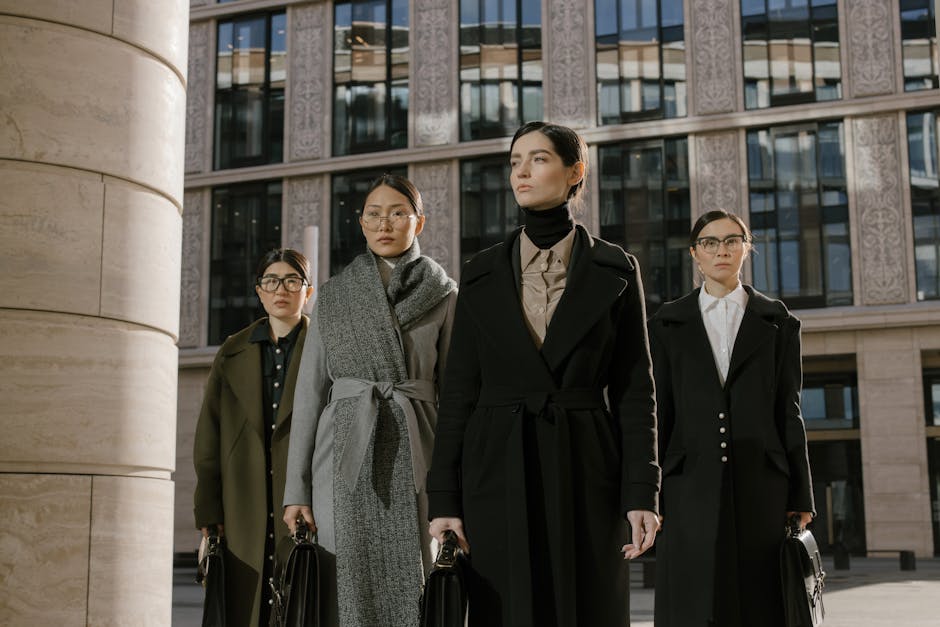
Each theme has a different cost structure, a different ideal workplace environment, and different maintenance requirements over time. The comparison below makes these differences concrete.
| Theme | Core Pieces | Best Office Fit | Starting Cost | Key Brands |
|---|---|---|---|---|
| Quiet Luxury | Cashmere knits, tailored trousers, leather loafers | Finance, law, senior corporate | $800–$1,500 | Theory, The Row, Banana Republic |
| Corporate Minimal | Straight-leg trousers, clean shirts, structured blazers | Most office environments | $300–$600 | COS, Arket, Massimo Dutti |
| Monochromatic Power | Tonal sets, single-color outfits, varied textures | Creative industries, media, marketing | $250–$500 | & Other Stories, Zara, H&M Studio |
| Elevated Business Casual | Wide-leg trousers, knit vests, midi skirts, loafers | Tech, startups, hybrid work | $200–$450 | M.M. LaFleur, Everlane, Madewell |
| Tailored Creative | Structured silhouettes with one bold element per outfit | Agencies, editorial, design studios | $300–$700 | Sandro, Reiss, & Other Stories |
What the table doesn’t show
Starting cost is what you’d spend to buy five to seven anchor pieces — the core that makes the theme functional and wearable across a full week. Additional purchases after that fill specific gaps rather than rebuild the foundation. The total wardrobe cost over two or three years is higher in all categories, but the spending rate drops sharply once the foundation is established.
The office fit column is the one most people ignore and then regret. Monochromatic Power dressing in head-to-toe rust reads poorly in a conservative legal environment regardless of how expensive the fabric is. Quiet Luxury pieces in a scrappy startup read as stiff and performatively formal. The theme has to fit the culture, not just your personal preference. Getting this wrong means wearing clothes that work in theory but create low-grade friction in practice every day.
Where Quiet Luxury breaks down for most people
Theory blazers run $300–$475. Quality cashmere knits start at $180–$250. Leather loafers at the appropriate quality level are $300 or more. The Quiet Luxury theme looks effortless specifically because it costs a lot to build — at lower price points, the pieces don’t hold the silhouette or carry the texture well enough to deliver the effect. Budget versions look like they’re trying hard to look like they’re not trying. That’s exactly the opposite of the intended result. If the budget isn’t there, Corporate Minimal delivers significantly better return on the same investment.
Monochromatic Dressing Is the Most Underused Work Theme
Most people treat head-to-toe single-color dressing as a fashion risk. It’s actually easier than building mixed outfits because the coordination problem is nearly eliminated by default. When everything in an outfit sits within the same color family, it works. The decision shifts from “does this go with that?” to “which pieces do I want today?” — a much faster question to answer at 7am.
The practical setup: choose one neutral — camel, navy, deep olive, burgundy, mid-grey — and build core work pieces within that color range in varying textures. A camel trouser, a ribbed camel knit, and a camel-adjacent structured blazer in a heavier twill create three distinct looks when layered differently. Add one accent piece in a deeper or lighter shade of the same family and the range expands without fragmenting into pieces that no longer connect.
The texture rule that holds tonal dressing together
Monochromatic outfits fail when every piece has the same texture and fabric weight. A matte navy blazer with a matte navy trouser in the same material looks like a mismatched suit, not an intentional tonal look. The fix is deliberate texture variation: ribbed knit against smooth twill, matte crepe with a subtle-sheen top, woven and knitted pieces in the same color family. The eye reads tonal coherence through color and visual depth through texture contrast. Both have to be present for the look to read as deliberate rather than accidental.
& Other Stories sells separates at £35–£95 designed specifically for tonal layering — their knit vests (around £55) and wide-leg trousers (£75) come in seasonal colorways that coordinate without being identical. Zara runs similar seasonal collections, though the quality gap between their price tiers is more pronounced. M.M. LaFleur has built their brand explicitly on this logic — their workwear dresses ($150–$175) and coordinating separates come in controlled color ranges designed to work together across multiple seasons without requiring a complete refresh each year.
Which work environments reward this theme — and which don’t
Creative industries are the natural fit. But monochromatic dressing also reads as polished in conservative offices when you choose the right color families. All-navy with texture variation works in almost any professional environment. The mistake is choosing a bold single color — bright orange, poppy red, electric green — for a tonal work look in a conservative setting. The theme isn’t the issue; the color selection is. In traditional offices, restrict the base palette to navy, charcoal, stone, and deep burgundy and the approach becomes entirely appropriate.
The Theme That Requires the Least Explanation

Corporate Minimal — straight-leg neutral trousers, clean shirts, a fitted blazer or two, quality flat shoes — is the theme that travels across industries without needing any justification. No bold moves, no trend-dependent pieces, no dress code interpretation required. It works in finance and it works in a tech office. Build the blazer and trouser foundation first; everything else fills in around them without misalignment.
The Mistakes That Collapse a Theme Before It Gets Going

Most wardrobe themes fail not because the concept is wrong but because of predictable execution errors at the start. These are the specific failure points worth knowing before you spend anything.
- Buying statement pieces before building the base. Themes run on foundations — neutral trousers, clean shirts, core blazers. A printed blouse with architectural sleeves has nowhere functional to go if you don’t own four neutral bottoms it integrates with. Build infrastructure first, accent pieces second.
- Trying to replace everything at once. Start with five to seven pieces, wear them for six weeks, then identify the actual gaps. Buying to complete a theoretical wardrobe on paper produces purchases that don’t fit your real routine or the way you actually get dressed.
- Spending unevenly — saving on anchors, splurging on accents. A cheap blazer worn four days a week degrades in two months. The anchor pieces carry the most wear; that’s where the investment goes. Keep trend-adjacent or accent pieces at a lower price point where replacement is easier.
- Ignoring care requirements relative to your actual schedule. Cashmere requires hand-washing or dry cleaning. If you’re wearing it three times a week and don’t have time for that upkeep, the pieces deteriorate fast and the theme starts looking worn before it’s established. Everlane‘s Japanese GoWeave trousers ($88) and Madewell‘s structured knits ($65–$90) are machine-washable and hold their shape — a meaningful practical advantage for high-frequency work wear.
- Choosing a theme your workplace culture won’t support. A Tailored Creative approach in a conservative financial institution requires constant justification and creates daily friction. Pick a theme that reads as appropriate without explanation, then introduce personality through accessories or color variation within the theme rather than through the theme itself.
When a tight theme actively limits you
Some workplaces treat personal style as creative signal — originality matters, and a strict wardrobe system can read as rigid or unimaginative. If you work in editorial, art direction, or fashion itself, a looser framework tends to work better than a fixed theme. A color palette rather than a system. A silhouette preference rather than a daily decision guide. The goal is to reduce friction, not add a different constraint that recreates the same problem in a new form.
The question of theme fatigue
Committing to a theme sounds like wearing the same thing indefinitely. In practice, the opposite tends to happen. When you stop spending attention on coordination, you redirect it toward quality, fabric, and cut — the details that actually differentiate good dressing from adequate dressing. Most people who’ve built a functional theme report noticing fabric weight, construction quality, and silhouette more precisely than they did when buying without a system. The theme doesn’t reduce interest in clothes. It focuses where the interest goes.
As work arrangements continue fragmenting across in-office, hybrid, and fully remote contexts, dressing systems that adapt without constant recalibration — Corporate Minimal and the tonal logic of Monochromatic Power dressing especially — will likely replace industry-specific dress codes as the dominant model. The relevant question is already shifting from “what does my office expect?” to “what system do I want to maintain across every context I move through in a given week?” Theme-based dressing answers that question in a way that buying pieces case by case never will.